Back in September, we noted that WBAI Radio began broadcasting an audio documentary on CBGB.
After pioneering Russian aviation and creating many world firsts, Igor Sikorsky fled the Bolshevik revolution finally arriving in New York a penniless immigrant. While his contemporaries struggled in the new Soviet Union, Sikorsky once again built aircraft, this time in an abandoned chicken coop. He helped pioneer transatlantic flight with Charles Lindbergh and his S.42…
The post Who Invented the Helicopter? appeared first on Channel Nonfiction.
Let’s face it. We’re oversaturated with visuals that are all style and no substance. In the era of ever-increasing visual content, capturing images that not only look pretty but also convey profound narratives is essential. Documentary photography serves as an exceptional medium of storytelling that goes beyond the constraints of mere image capturing. Furthermore, this art form also allows you to reveal truths, tell tales, and evoke emotions, transforming the viewers’ perspective. In this article, we’ll dive deep into using documentary photography to tell authentic stories through images.
What Is Documentary Photography, and Who Does It Serve?
So, what is documentary-style photography? In short, documentary photography primarily chronicles significant and historical events. It typically exists in professional photojournalism or reportage, but it may also be an amateur, artistic, or academic pursuit.
Here are some examples of documentary photography goals:
Historical Documentation: Documentary photography records historical events, societal changes, and everyday life. Because they capture moments in time, documentary photos help us understand the context, people, and impact of past events.
Social Commentary: Many documentary photographers aim to start conversations about societal issues. They do this by presenting viewers with images that depict realities that may be ignored or overlooked. For example, a photo series on homelessness might shed light on the severity of the problem in a particular city or country.
To Inform and Educate: Documentary photography can play a vital role in educating the public about events, issues, or topics. Through visual imagery, photographers can convey complex issues in an easily understandable and impactful way.
Advocacy and Raising Awareness: Documentary photography can also advocate for change or raise awareness about a particular issue. For example, images depicting the impacts of climate change or the effects of war can drive people to action.
To Humanize: Documentary photographers often aim to humanize their subjects, especially in cases where they are part of marginalized or misrepresented groups. As a result, photographers give a voice to these individuals, allowing viewers to empathize and better understand their experiences.
Artistic Expression: Even though documentary-style photography focuses on representing reality, it doesn’t mean it can’t be creative. In fact, many documentary photographers have cultivated their own unique styles and perspectives. Incorporating creativity into their work elevates their images beyond simple documentation into the realm of art.
A History of Documentary Photography
From the 18th-Century Until Now
The history of Documentary Photography started with Social Documentary Photography, a form of photography that uses visual storytelling to highlight societal issues. An iconic example of this genre is Lewis Hine’s 1911 image “Breaker boys sort coal in at an anthracite coal breaker near South Pittston, Pennsylvania.” Hine’s photographs were instrumental in promoting social reform, such as the 1916 Keating-Owen Act that addressed child labor.
During the Great Depression and the Dust Bowl, Social Documentary Photography expanded its reach. Famous documentary photography from photographers Dorothea Lange and Walker Evans depicted the struggles of impoverished Americans. These images created a powerful archive of rural poverty. This trend even brought about new sub-genres, such as the “Madonna and Child” trope, symbolizing the plight of poor mothers.
“Destitute pea pickers in California. Mother of seven children. Age thirty-two. Nipomo, California” by Dorothea Lange (best known as ‘Migrant Mother’)
Conservation Photography
Next comes Conservation Photography, tracing its roots back to the 1860s in the U.S. This type employs a documentary style to capture nature and landscapes to promote their preservation. Key contributors include Carleton Watkins and Timothy O’Sullivan, whose images highlighted the beauty of Yosemite and Western landscapes..
Furthermore, through their painterly and photographic work, Thomas Moran and William H. Jackson enhanced public awareness about Yellowstone National Park.
In the 20th century, Conservation Photography experienced a resurgence with notable contributions from Ansel Adams, whose stunning images of Yosemite influenced the wilderness movement. The discipline continues to evolve in the 21st century, reflecting global environmental concerns.
Photo Essays
Popularized by magazines like Life and Look in the 1930s, photo essays combined narrative photography and written storytelling, often focusing on societal issues. Notable practitioners like Walker Evans set the genre’s standards.
Post WWII, photographers like Robert Frank and W. Eugene Smith pushed against the genre’s constraints, leading to an evolution towards documentary work, epitomized by Smith’s famous documentary photography images of Minamata in Japan.
The rise of television as a documentary medium and the closure of crucial magazines prompted a shift towards book publishing and gallery exhibitions by the 1970s, with photo essays often featured in art gallery settings.
Photo of Anacostia Boys by Gordon Parks
Social Landscape Photography
“New Documents,” also known as “Social Landscape” photography, originated in 1967 as a reinterpretation of Documentary Photography, emphasizing the exploration of life as it is. Today, it is very similar to Street Documentary Photography. Led by photographers like Robert Frank, Diane Arbus, and Lee Friedlander, this genre celebrated societal imperfections, presenting raw, often disquieting depictions of everyday reality.
These photographers used personal influence and self-awareness, shifting from the traditional objective lens of Social Documentary to a more introspective viewpoint. Notable trends in this movement included focusing on sequential imagery in photographic books and incorporating new subjects, such as suburban landscapes and color documentaries.
Ethnographic Photography
The Ethnographic Photography genre, evolving from early Documentary Photography, captures cultures worldwide, becoming a photographic tourism in the 19th century. Pioneers like John Beasley Green, who documented Egyptian ruins, made it a credible scientific record.
The genre was institutionalized through platforms like National Geographic Magazine, formerly a scholarly journal. The Farm Security Administration (FSA) and the British Mass Observation Project further strengthened this style, focusing on societal issues and public sentiments.
In the 1960s, art theorist Hal Foster observed the shift of art toward visual ethnography with trends like Performance Art blurring artist-audience boundaries. Works like Jeremy Deller’s The Battle of Orgreave (2001) exemplify this, showcasing how artists recover suppressed communal histories.
War Documentary Photography
The War Documentary Photography genre, originating with John McCosh’s images of the Second Anglo-Sikh War in 1848, captures the grim reality of war. Early photographers like McCosh and Roger Fenton, the first Official War Photographer, focused on static scenes due to technological limitations.
Matthew Brady’s work during the American Civil War, particularly his “The Dead of Antietam” exhibit, brought war’s brutality to the public eye.
Technological advancements in the 20th century allowed soldiers to carry cameras, leading to raw and unfiltered images from World War I.
The handheld Leica 35mm camera’s invention in 1925 brought War Documentary Photography closer to Photojournalism, with notable figures like Robert Capa capturing iconic war images for mainstream publications.
Photo of “The Falling Soldier” (1936) – Robert Capa
One of my favorite war photographers is the American photojournalist James Nachtwey, who witnessed some of the most brutal and significant moments of history since the late 20th century. His book, “Inferno,” is a chilling documentation of wars and conflicts from around the globe.
Documentary Films
The documentary film is a genre believed to be defined by Boleslaw Matuszewski in 1898; it initially developed with travelogue and city symphony films in the early 20th century, presenting scenic views and non-narrative structures, like the 1921 film ‘Manhatta.’
Avant-garde influence, like in Luis Buñuel’s 1933 film ‘Las Hurdes: Tierra sin Pan,’ persisted alongside feature-length documentaries, such as the successful ‘Nanook of the North,’ despite its authenticity controversy due to staged scenes.
By the 1930s, the genre evolved into political and propaganda films with an ideological bent. Social documentaries promoted political reform, like ‘Misère au Borinage’ in 1934, while government-backed propaganda films, such as Leni Riefenstahl’s ‘Triumph of the Will,’ championed specific ideologies, notably Nazi beliefs in the 1930s.
Documentary Realism, a post-WWII Italian film style, focused on the everyday lives of regular people in post-war or Nazi-occupied Italy. To this end, it used improvisation and nonprofessional actors for an authentic feel. You can find it showcased in films like Rossellini’s Rome and De Sica’s The Bicycle Thieves.
Influenced by the ideas of French critic André Bazin, who favored unobtrusive filmmaking, the Cinéma Vérité movement emerged in France. Led by Jean Rouch and Edgar Morin, it aimed for pure realism, with Chronicle of a Summer serving as a critical example.
In Britain, the Free Cinema movement emphasized filmmaking free from commercial and propagandist influence. In short, it concentrated on the lives of the working class. Using handheld cameras and non-linear narration, they created inexpensive documentaries on 16mm black and white film stock.
Example: Lindsay Anderson’s O Dreamland
Documentary Photography Now
Facing challenges from television media and the rise of postmodernism in the 1970s, Documentary Photography evolved to incorporate a critique of authorship, cultural bias, and appropriation. Adopting a postmodern lens, photographers began to explore marginalized communities and cultures, often from an ethnographic perspective.
Some documentary photography examples include:
- Don McCullin’s urban strife depictions
- Manuel Rivera Ortiz’s portrayal of rural village life
- John Ranard’s work on the boxing world and Russian prisons
- Sebastião Salgado’s studies on global labor and migration
- Graciela Iturbide’s immersion in indigenous Mexican communities
How to Do Documentary Photography?
Before diving into Documentary photography, you first must master the basics of ISO, aperture, and shutter speed. Beyond the technical aspect, this type of photography is centered around storytelling, perhaps more so than other niches.
As a documentary photographer, you’re not just a silent observer but an active participant. You will immerse yourself into the milieu you’re documenting. To truly master this craft, there are some documentary photography ideas and key points to remember.
[Related Reading: Documentary Photography: Adding Family Photojournalism Sessions To Your Portrait Business]
Research Is Key
Research is the lifeblood of a documentary photographer. With this in mind, get to know the stories, the people, and the environment before photographing them. As a result, actual authentic images will emerge from the depth of understanding.
Pro Tip
Don’t limit your research to conventional sources. Intelligent researchers know to tap into varied resources. Use online forums, social media trends, podcasts, or even local community meetings to gain a comprehensive understanding of your subject. This can also help reveal unconventional narratives and perspectives, providing a richer context for your work.
Create Connections
Photo by Roudy Salameh
Documentary photography thrives on establishing genuine connections with your subjects. Let them feel your presence and get comfortable around your camera. In time, they’ll serve you raw, unfiltered moments on a silver platter.
Pro Tips
These tips may sound like they’re canceling each other, but they’re actually both important. In time, you’ll learn to master them both simultaneously.
- Learn the art of blending into the environment. Your presence should not alter the behavior or routine of your subjects. Respect the personal space of your subjects, so you can capture life as it naturally unfolds.
- Don’t just be a visitor, be a participant. Spend days, weeks, or even months immersing yourself in the lives of your subjects. Additionally, share meals with them, join their celebrations or their mundane daily activities. This immersive experience will provide a depth to your photos that can’t be achieved with a casual visit. As a result, your chances increase for creating profound narratives instead of just snapshots.
Patience Is a Virtue
Rome wasn’t built in a day, and neither is a powerful photograph. Patience is your best friend when it comes to capturing those blink-and-you’ll-miss-it moments. From time to time, you might need to wait hours, days, or months to capture the perfect shot. As Henri Cartier Bresson would put it, you need to find “The decisive moment.”
Ethical Considerations for Documentary Photography: The Fine Line
This is an important point! Remember, as a documentary photographer, it’s your responsibility to respect the dignity and privacy of your subjects. Abiding by ethical guidelines ensures the integrity of your work while demonstrating respect for the communities and individuals you’re portraying.
But how can you do that? What rules do you have to follow? Here are some critical guidelines:
Informed Consent
Always get permission from your subjects before you photograph them, especially if you intend to publish or distribute the photographs in any way. Subjects should understand how and where their image will be used.
To simplify this, you can create a consent form. In this form, include the project and expected photograph usage – social media, magazines, etc. Also, include a section mentioning the subject’s rights to withdraw from the project at any point.
Before publication, show your subjects the photographs taken to confirm if they are content with their use as outlined in the informed consent document – to avoid potential disputes after publication.
Respecting Privacy
Sometimes, it can prove difficult to balance the ethics with your ability to tell the story in an engaging way. This holds especially true when you want to tell the story precisely to make a difference. In this situation, it’s hard to dismiss the ethics.
Above all, it’s crucial to respect people’s privacy and not to photograph in places where individuals have a reasonable expectation of privacy. Photographers should always respect the personal space and limits that the people they are taking pictures of. Hold to this even if these limits stop you from telling the story you want.
If you’re unsure, always ask the person for permission to take and use their photos. The most essential thing is that you make the people you’re photographing feel comfortable. Make them trust you. So, be honest about your intentions and your role.
Building Trust and Protecting Your Subjects
Consider the potential harm your photographs might cause to your subjects, whether it’s embarrassment, stigmatization, or even physical danger. Always prioritize your subjects’ well-being above getting the perfect shot.
Truth and Accuracy
Documentary photography is often seen as a form of visual journalism. Because of this, you should strive to depict situations as accurately and truthfully as possible. Do not manipulate images in a way that alters the reality or context of the scene.
Critics argue that digital editing practices compromise the integrity of the images and the photographer’s role as a reliable observer of events. For the preservation of ethical standards in documentary photography, it’s crucial that photographers remain transparent about their photo manipulation.
Documenting Vulnerable Populations and Individuals
The terrain of documentary photography often brings photographers face to face with vulnerable groups and individuals, such as the homeless, refugees, or impoverished populations. Appropriately photographing these populations necessitates respect for their dignity and sensitivity to their circumstances.
Biases can unintentionally skew the representation of the subjects being photographed. In turn, this often leads to a false or oversimplified portrayal. This can occur due to a lack of understanding of the cultural nuances, preconceived notions about a certain group of people, or personal beliefs.
Photo by Mart Production
Always strive to understand and respect the cultures and customs of the people you photograph. This can help prevent offensive or harmful misrepresentations and aid in portraying your subjects faithfully. Introspectively acknowledge your biases and actively strive to counter them.
Exploitation in this context can manifest in many ways: sensationalism, dehumanization, intrusion, or voyeurism. To avoid this, photographers should avoid reducing their subjects to mere objects of pity, fascination, or scorn. Instead, their work should aim to humanize, to enlighten, and to provoke thoughtful conversation.
Technology Infringing on Privacy
Technology like geotagging, which records location data in image files, is a beneficial tool for photographers to manage their photo collections. However, if not used cautiously, it could expose sensitive information, like the home addresses of vulnerable subjects, to individuals with malicious intentions.
Furthermore, certain editing software use facial recognition to identify people in photos, which can pose severe privacy threats.
Credit and Recognition
Provide appropriate credit to the individuals, groups, or communities featured in the photographs. This means recognizing their contributions in the context of the story being told, and if applicable, naming them in photo credits. Their stories form the backbone of the work, and it’s only fair and ethical that they’re acknowledged for it.
Pro Tip
If you want to get deep into the topic, listen to this insightful talk about ethics in documentary photography between photographers Sarah Waiswa, Liz Hingley, and Savannah Dodd.
Crafting Your Visual Story via Sequencing
Sequencing is essentially the art of arranging the puzzle pieces. Each one is vital, but the true magic happens when they all fit together, creating a story greater than the sum of its parts. Paul Taggart has an excellent course on this that takes you step-by-step into making your own photo essay.
Here’s a summary of the key factors that are important when composing your story:
Identify Your Narrative Arc
Just like a good book or movie, a visual story should have a beginning, middle, and end. This gives it structure and helps guide the viewer. As an example, the opening could introduce the main characters or the setting. Then, the middle might be the unfolding of the main event or the escalation of the conflict. Finally, the end should tie up loose ends and leave the viewer with a clear sense of closure.
Visual Variety
Using a variety of shot types – wide, medium, and closeup – will provide different perspectives to engage the viewer. Wide images set the scene, medium shots give it context, and close-ups provide intimate details. Mix these shot types to maintain the viewer’s interest and offer a comprehensive sense of the story.
The Power of Juxtaposition
The way we position images next to each other can create new meanings that weren’t present in the individual photos. For instance, consider a picture of a wealthy person dining in luxury placed next to a picture of a homeless person searching for food. This juxtaposed layout creates a powerful commentary on social inequality.
Use of Color and Light
Color and light can create mood, evoke specific emotions, and highlight essential elements of your story. For example, warm colors might suggest joy, passion, or lightness, while cool colors can evoke sadness or tranquility. Shadows and contrasts in lighting can heighten drama and suspense.
Continuity and Transitions
Ensure there is a visual continuity between your images. For instance, this could be through using similar colors, themes, or subjects. Also, consider including transitions between shots. An abrupt transition might create shock or surprise, while a smooth transition can maintain a serene, flowing narrative.
Reflect and Refine
After your initial sequencing, take a step back. Look at your story as a whole. Does it flow? Is there a straightforward narrative? Are there any images that disrupt the flow or seem out of place? This reflection is crucial for refining your story and making it more effective.
Other courses on Documentary Photography and Photojournalism:
- Documentary photography projects by Marcos Zegers, Photographer
- Introduction to Visual Journalism by Gladys Serrano, Documentary Photographer, and Videographer
- Introduction to Photojournalism: Capture Powerful Stories by Finbarr O’Reilly, Photojournalist
- Photo Essay: Telling a Family Story (a course on documentary family photography) by Paul Taggart, Photojournalist
Wrapping Up
Creating compelling visual stories through documentary photography demands skill, patience, empathy, and ethical sensitivity. As Magnum Photos co-founder Henri Cartier-Bresson once said, “Photographers deal in things which are continually vanishing, and when they have vanished, there is no contrivance on earth which can make them come back again.”
The best documentary photography is about finding and sharing the unseen, the unheard, and the unfelt aspects of human existence. When doing a documentary account of something, ask yourself, does your narrative evoke the emotions you intended? Furthermore, does it accurately represent the story you wish to tell?
To further enhance your technical skills and actually focus on the story in front of you, consider exploring additional resources and tutorials offered by OhMyCamera.
**Feature image, “Children in Seville, Spain,” by Henri Cartier-Bresson.
After pioneering Russian aviation and creating many world firsts, Igor Sikorsky fled the Bolshevik revolution finally arriving in New York a penniless immigrant. While his contemporaries struggled in the new Soviet Union, Sikorsky once again built aircraft, this time in an abandoned chicken coop. He helped pioneer transatlantic flight with Charles Lindbergh and his S.42…
The post Who Invented the Helicopter? appeared first on Channel Nonfiction.
Matt is joined by Puck media correspondent Julia Alexander to recap the year in streaming, and hand out awards for Streamer of the Year, Most Disappointing Streamer, Show of the Year, Biggest Surprise Hit, and highlight the most interesting trends in streaming.
The post Top Streaming Stats 2025 appeared first on Channel Nonfiction.
Matt is joined by Puck media correspondent Julia Alexander to recap the year in streaming, and hand out awards for Streamer of the Year, Most Disappointing Streamer, Show of the Year, Biggest Surprise Hit, and highlight the most interesting trends in streaming.
The post Top Streaming Stats 2025 appeared first on Channel Nonfiction.
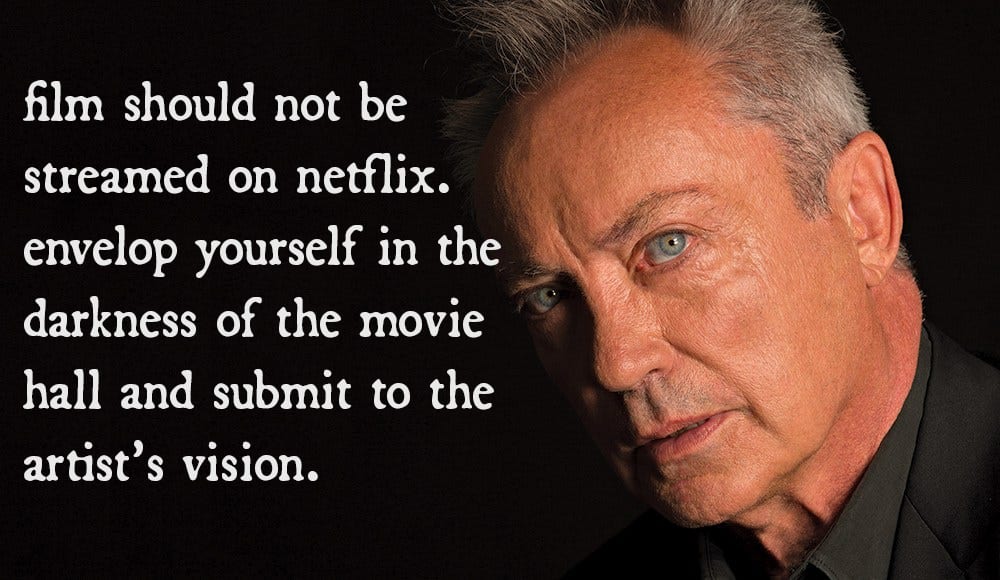
Udo Kier died recently, so a lot of people have been sharing this, the one and only post ever made to his Twitter account back in 2011:
film should not be streamed on netflix. envelop yourself in the darkness of the movie hall and submit to the artist’s vision.
Yes! Filmmakers shouted, Submit to my vision!!!
Only a cinephile knows what it means to submit to an artist’s vision for more than a few minutes. (And frankly, only great filmmakers have any idea what to do with that sustained attention.) Cinephiles want the rewards we can only earn from sustained, patient, open-minded attention. The rest of us have the TV on in the background while we scroll our phones.
But Udo Kier called it way back in 2011 and by now we all see what he was shouting into the void about: conjuring the attention needed for the ‘cinematic’ experience is harder in the streaming era.
I am not saying anything original here. What I am saying is: I confess. I am part of the problem. I can blame the pandemic or Big Tech or work stress or whatever, but I once read long, difficult books, and now I barely read at all. I once watched long, difficult films, and now I barely watch films at all.
To be clear: I still read and watch films a lot more than most people; it’s just a lot less than it used to be. And let’s be real: books and films combined is nowhere close to my annual 90 Day Fiance consumption. Like, just that one franchise.
This weekend I watched several movies at home: The Fabelmans, Close Encounters of the Third Kind, and Ryan White’s incandescently beautiful Come See Me In the Good Light (it’s on Apple, check it out!). As usual, I struggled to focus for more than a few minutes at a time and had to really work hard at it. And these are some, you know, really good movies! They reward the attention!
What does this mean for my own work?
I am still trying to make every film ‘cinematic,’ but I also grapple with the reality that viewers are half-watching at best most of the time, if you’re lucky enough to get them in the first place. I know that in the streaming era you have like 10 seconds to grab a viewer and keep them, thus there is real utility in that “first scene is a trailer” thing, which my cinephile self hates, but my working-hack self is like… well… I love cinema, but I love other things too, like food and rent, and actual viewers?
We ended up embracing the “first scene is a trailer” convention for Happy and You Know It (COMING SOON TO HBO MAX!). I don’t think it ruins the movie in a theatrical setting, but you could also cut it and it’d be fine. You could cut it and it may be better — if by better we mean more cinematic. On streaming though, I think that first scene might be really helpful to getting and keeping an audience?
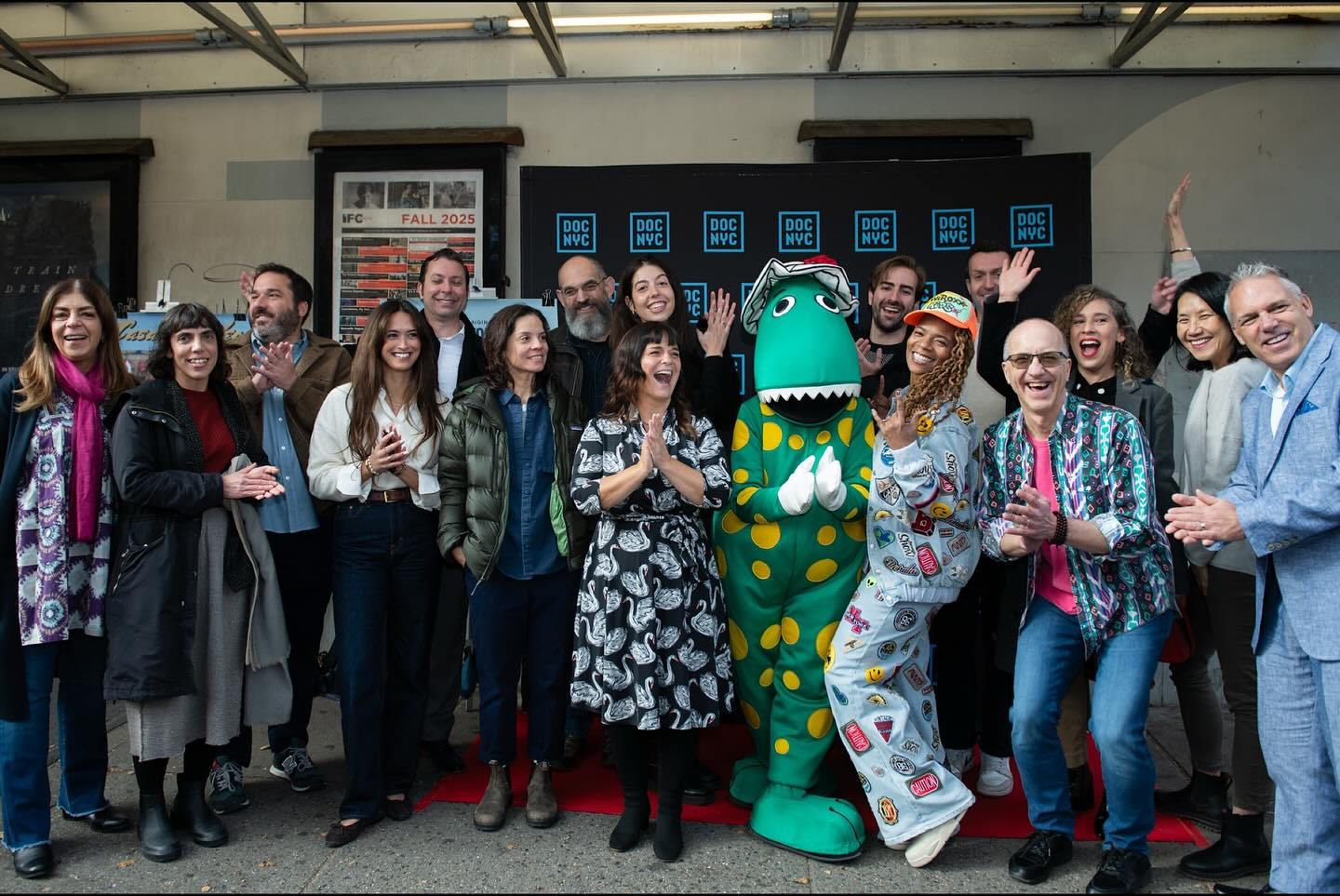
It’s important to say Happy and You Know It was made for and with HBO — so we knew that streaming was the main event all along. I loved seeing it with an audience at DOC NYC, but we also knew all along that was not the main way people would see it. And that’s not true for everything I make.
DOC NYC was so fun, and I thought the movie played great in a theatrical space (as many funny movies do).
Most of the time I’m more just confused. And more confused with each passing day:
It’s like, am I making movies or not? Am I making TV? Am I making streaming content? Why I am still so committed to the theatrical feature length? Is it just what I’m used to, or do I want to stand on a hill and fight for it?
Most of all I worry: If I don’t envelop myself in the darkness of the cinema hall and submit to the artist’s vision all that often myself… who am I to ask that of viewers?
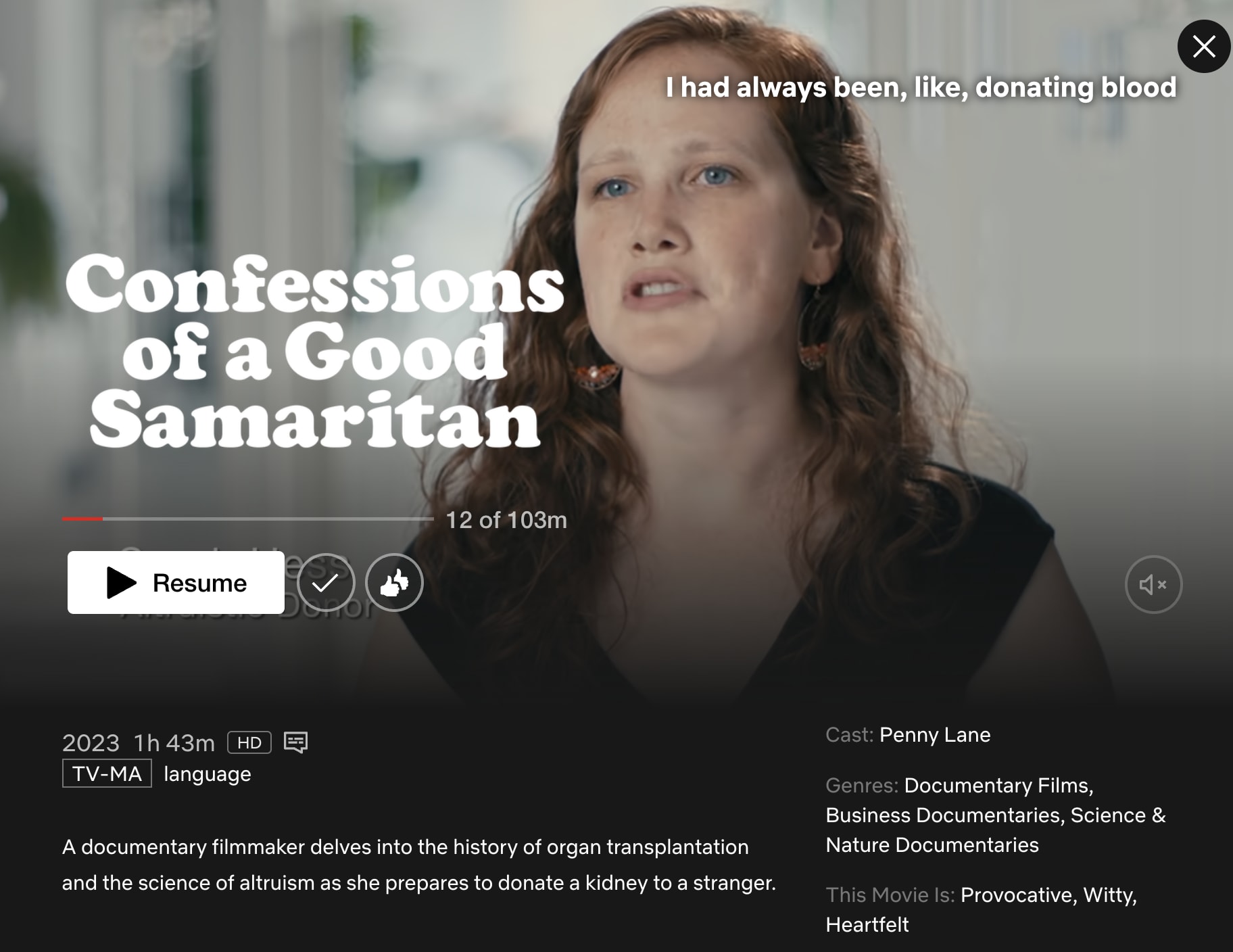
When Confessions got licensed for Netflix (a shocking and welcome development! which in full transparency involved very small amount of actual money), I watched the whole movie again, thinking about how I personally engage on that platform. I was like, oh shit. The first 2 minutes is just like, colors and music swirling around! There are long scenes with no dialogue, only text on screen!!
I called producer Gabriel in a panic and asked, “should we make a Netflix cut? I think the opening is a problem.” He disagreed and said he stood by our film, so I dropped it (also I dropped it because we are too tired to recut the movie, who is going to pay for that, we already got the deal, etc.)
But with Confessions, I didn’t make it for Netflix! I’m thrilled it is there, but we made it independently, with full creative control, mainly imagining movie theaters full of people. I think most of us movie-makers still do this, against all common sense perhaps, but because we are cinephiles at heart.
I’ve really admired how Sean Baker is using his success to actively fight for cinema and for the cinematic experience. But documentary is different; in my lifetime, it’s always been more supported by TV (then streaming) than by theatrical anyway. So my sense of what I am making, and for whom, has always been a little more muddled to begin with.
How are you thinking about attention, and what to ask of viewers, in this confusing era?
George Lucas says he’ll map out the story this way:
30 scenes x 4:00 or 60 scenes x 2:00.
In documentary we’re usually aiming more toward 90:00 total run time, so what is that? 30 x 3:00? 45 x 2:00? 90 x 1:00? I have no idea how anyone else is doing this, but here are some thoughts on how I am.
Here’s a basic structure I sometimes look at for a 90:00 documentary. Currently this is pasted on top of the Wild Inside edit board:
I forget who created this originally and I forget who gave it to me. Thanks, whoever(s)! Please identify yourselves!
I’m always looking at the math. How many characters? Each one will probably need 3+ scenes if you want to give them an arc (beginning/middle/end). How many storylines? Each beat of every storyline: how many scenes will those take? And so on. I’m mapping this out in pre-production, I’m mapping it out during casting and filming and editing, and I’m still mapping it out when we get to picture lock.
It was the math that alerted me early in production on Mrs. America that we were in trouble. We were trying to make a character-driven but expansive feature-length documentary, but we had too many characters and too many story beats for it. We had barely started shooting, but already the math was not mathing.
We tried cutting characters, but each one turned out to be an essential part of the whole. Then we tried cutting larger sections of the story, but then the story didn’t work. We tried making every scene very short ( ~1:00), but that didn’t work stylistically or emotionally. That’s why we pivoted to a 4-part series. That project is in limbo, which I hate and I want to finish it please. But the math did not lie!
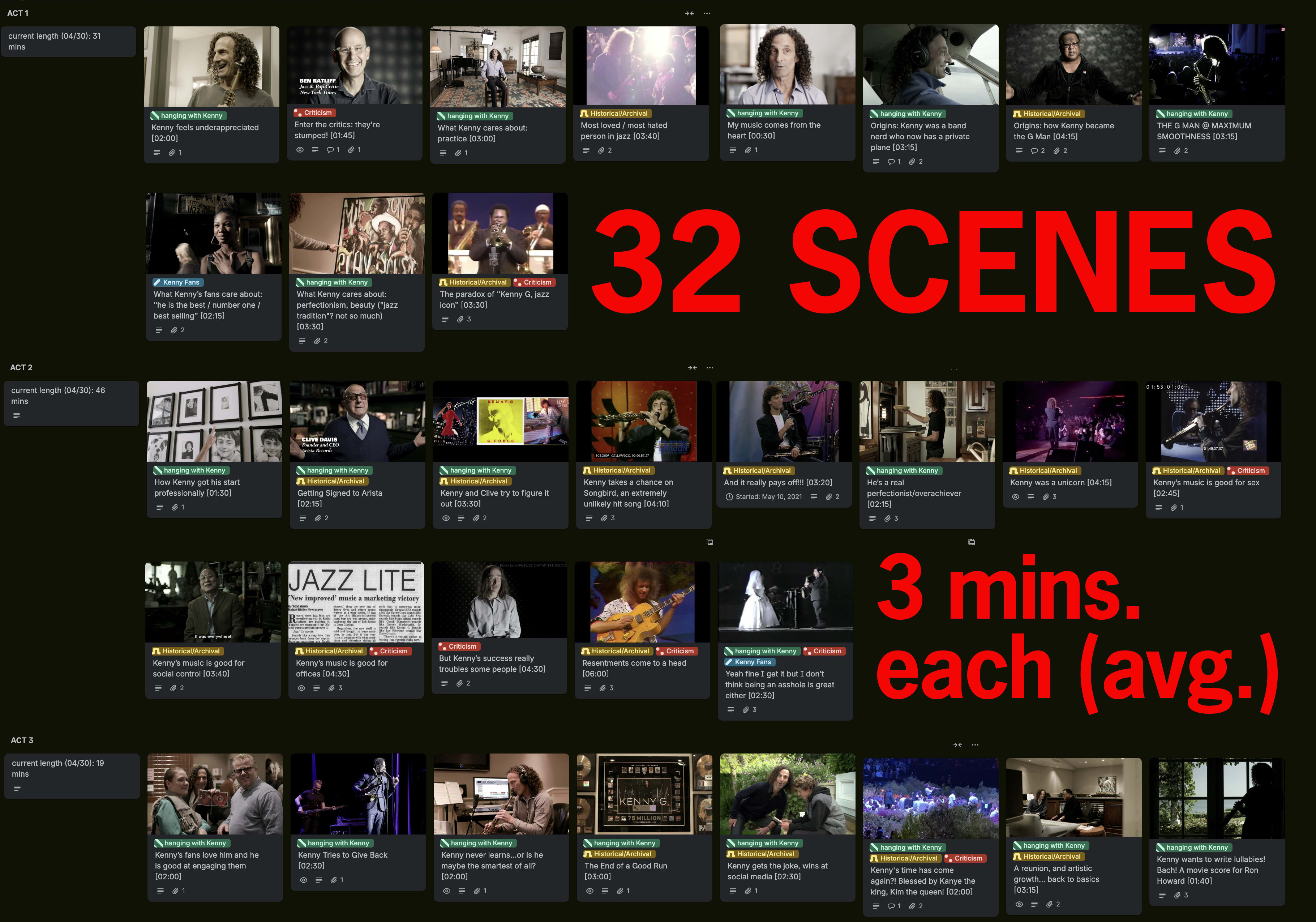
Here’s the Kenny G board. This has 32 scenes. Most are 2-3 mins long. Some are 4 mins, which I’m sure I could have broken into smaller scenes (more cards):
In pre-production, I’ll aim for 30 scenes, and we go from there.
Our first rough cuts tend to have much longer scenes, more like 5-8 mins long. I call these ‘the options cuts’ because we are leaving in lots of redundancies, be that mechanical or emotional or whatever. Over time, we whittle them down to whatever seems essential, and they seem to end up around 2-4 mins.
I think 2-4 mins scenes are considered pretty normal and standard these days in doc (??) but I’m not sure. I do think it’s funny that following my intuition over many years, with no plan and no studying: I ended up completely obeying George Lucas. How do you all do the math?
I love this trailer!
SHOUTOUT Khalid West and the HBO Max Marketing A/V team, who created it.
I want to share a couple things I’ve learned about making trailers, even though I don’t know how to make trailers. I have tried making trailers, and no thank you, that is hard and specific, so I say: god bless the trailer cutters! So, really what I know how to do is ‘give notes’ on a trailer.
But first: do you know anyone looking for office space in Brooklyn? If so, please send them my way because we are looking for suite-mates now that the wonderful crew at Marshall Curry Productions have moved on. Here is a listing for our space in the gorgeous Old American Can Factory.
Step 1: take a deep breath and remember this is not the film, this is a trailer
If you are like me, it can initially be confusing and even disturbing when you first see the film you labored over for years sort of ‘put into a blender’ + spit out as a trailer. TBH, for me, this is hard every time. I find I usually need to let it settle for a bit to get over the initial shock. And I remind myself, It’s not the film, it’s a trailer! A trailer is literally an advertisement!!
Step 2: discern what is the pitch being made
I look at the big picture first: what are the sections, what does each one communicate, in what order? What’s the initial hook, what are the turns and layers? Does it capture what I think people will love about the movie? Or is there a new pitch here I’ve never even considered before?
Step 3: give specific suggestions
After I digest and outline that bigger-picture summary, I consider whether I might suggest moving the sections around, or subtract/create/combine sections. Then I make a list of specific swaps for dialogue or shots that I think might work better in specific instances. I try to include timecodes or screenshots to make it easy for them to find these suggestions. I do not assume they know where “the bunny shot” is.
Step 4: stay in your lane… but know what you know
I do not know how to make a trailer, so I don’t assume any of these ideas will work.
But also… I know what I know. By trailer time, I’ve usually been pitching the film in one way or another for years. I know what made people’s eyes light up with delight or what made them look confused, what turns them off and what makes them want to know more. I also know what their expectations are, and what works to surprise them. My job here is to convey all of that marketing information to my team.
But here’s the really important thing to remember for the trailer — and it’s not just about the trailer, it’s about all the marketing materials — the poster, the featured stills, social media content… It’s something I forget to do every. single. movie. When will I ever learn??!
Here are 2 ethical dilemmas from just this week, in the process of finishing a new film:
Dilemma 1: When does a particular usage of archival become an ethical breach?
Wild Inside is heavily crowdsourced: in addition to all the stuff we filmed, we are using photographs and videos from hundreds of people. In the edit, we’re sometimes pairing the specific photographs of interviewees with their testimony. So Person A is speaking, and we’re seeing Person A’s photographs at the same time, and we understand the images to be Person A’s, without any necessary further attribution. Fine.
But sometimes, the scene demands something else. Perhaps Person A is the best narrator of an event in Flaco’s life, but they didn’t have the right photo from the right season, or the right action, or the right time of day. Or, even more often, we generally privileged moving image, because we are working in a moving image medium, but most of our contributors are mainly still photographers. In any case, the needs of the film might mean Person B’s archival is being seen while Person A is speaking, and it might seem — or be vaguely implied — those images were created by Person A. When is this a problem?
Some factors:
(a) Some of these folks earn revenue by licensing or selling their photos. Creating a particular impression of their work in my film could affect their business interests (this seems pretty unlikely, but I have to consider it).
(b) Some of them might be annoyed by specific instances of this for various personal reasons. I assume I don’t know all the interpersonal dynamics at play, but I know enough to know they exist. All things being equal, I’d like to be sensitive to this.
(c) None of this is very important! I may inadvertently create a perception of something not exactly true, but it’s not like, going to affect the election, or really mess up the historical record, or do anything else really dire (I don’t think???). It’s also not as if I am vaguely implying someone did something immoral or illegal (that’s not a dilemma — I just wouldn’t do that!). Most of the truly important ethical issues have been ironed out at this point, frankly.
We made a list of all instances where we’re using archival in a way that raises these questions, and we’re just going through it, in conversation with our subjects, making decisions and adjustments on a case-by-case basis.
I’m about to introduce baby’s first paywall, which is pretty cringe, but also necessary if I’m going to really put myself into writing, and justify time taken away from filmmaking. I’m not big on gatekeeping what I know — I really do try to be honest!— and there’s nothing I would write here that I probably wouldn’t spill in a consult, or a guest lecture, or at a party. But I don’t go to a lot of parties these days; good luck getting me out of my apartment (I’M TIRED, LEAVE ME ALONE), and not everyone can afford to hire me as a consultant or an EP.
I am still developing the whole big plan for this newsletter, and I’ll be asking for feedback soon, but for now suffice it to say: free subscribers will get good stuff, but paid subscribers will get even more good stuff. And more access to me, personally.
Dilemma 2: Should I use AI to change dialogue in the edit (*gasp*)????