
An eye-opening sequence in the documentary The Sandbox gives director/producer Kenya-Jade Pinto a bird’s eye view of the migration crisis. She accompanies the Sea-Watch Aerial Crew, an independent operation that observes the Mediterranean Sea for asylum seekers in distress, while sitting in a small plane that follows the boundary of Tunisian military airspace. The plane tours the water as Sea-Watch’s Oliver Kulikowski trains his camera with a zoom lens towards the open waters.
The lean crew of eyes in the sky notices what they’re looking for: a small aluminum fishing boat sits stranded in the waters, its engine seemingly kaput. The vessel looks jam-packed from bow to stern with people. They wave frantically at the airplane. “The boat is in distress,” someone in the airplane says. “They require assistance.”
That human voice provides a sharp counterpoint to another migration story in The Sandbox. A figure known as Ramón (a pseudonym) tells Pinto and journalist Lydia Emmanouilidou about surviving a shipwreck while escaping Libya. Ramón recalls being stranded when the fishing trawler Adriana sank off the coast of Greece in June 2023. The tragedy left 600 asylum-seekers dead. Ramón reflects how the deaths were preventable, yet seemingly calculated as he remembers a drone checking in on the boat a full day before it sank. Ramón and company didn’t pass the cost/benefit analysis for whatever or whoever was on the receiving end of the drone feed.

The Sandbox asks what happens when one removes humans from the equation while mobility and border-crossings become increasingly driven by artificial intelligence, technology, and military enterprise. This story is not about technology. It’s about the people lost in the voids created by the algorithms.
The film, which has its North American premiere at Toronto’s Hot Docs after debuting at CPH:DOX in Copenhagen, marks a promising feature directorial debut for Pinto. The filmmaker brings a unique perspective to The Sandbox as her training as a lawyer informs her work both as a photographer and filmmaker. The documentary’s visual style evocatively considers the liminal spaces people navigate in search of new lives.

Pinto, speaking with POV via Zoom, says her studies on refugee and international law at the University of Ottawa helped to set the story in motion, as did her own family’s experience moving to Canada years ago. “I came to Canada with my family under what’s called a humanitarian and compassionate grounds application,” explains Pinto. “These are super discretionary applications in the Canadian law context—the types of applications where there’s an extenuating circumstance and you’d really like a human to read the file.
“I learned a few years ago through some work that academics were doing, including the work of Petra Molnar through the Citizen Lab, that those applications in the Canadian context were starting to be outsourced to algorithms. I started to think, ‘If that had happened to us, I’m not sure what would’ve happened.’ Maybe we wouldn’t have been able to come to Canada in the end.”
The director says that work by academics like Molnar, whose 2024 book The Walls Have Eyes: Surviving Migration in the Age of Artificial Intelligence, helped to fuel her curiosity with its prescient analysis of algorithmic containment and surveillance of border crossings. So too did the work of journalists like Lydia Emmanouilidou, whose reporting on the migration crisis, including telling Ramón’s story, factors into The Sandbox.
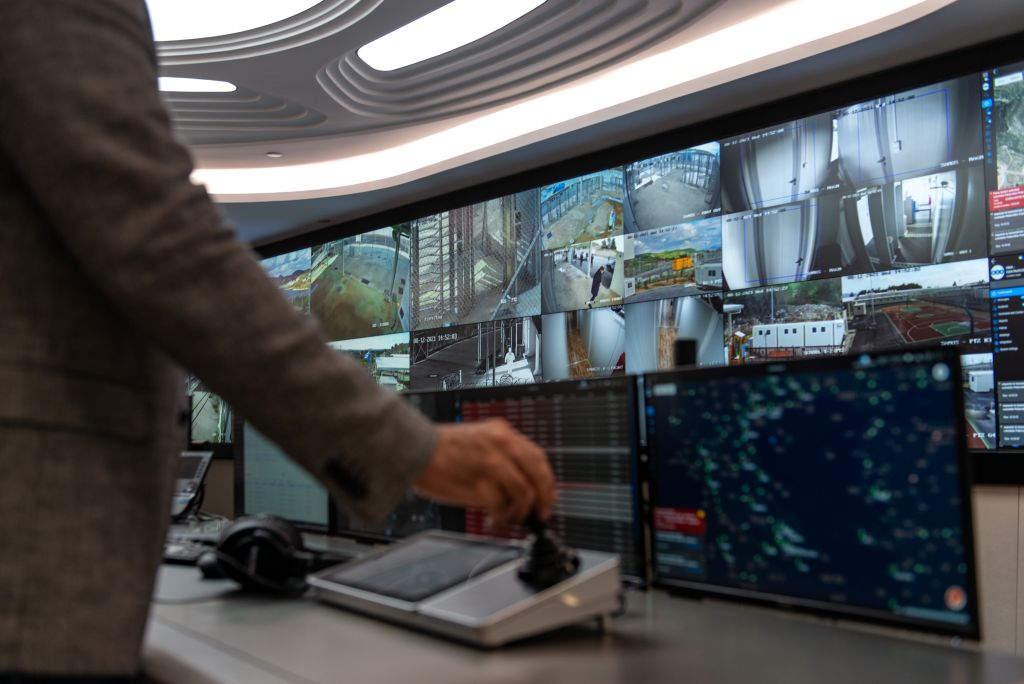
One sequence follows Emmanouilidou into the control room of Greece’s Ministry of Migration and Asylum. Pinto’s camera captures an array of monitors as the Big Brother-like surveillance system watches all angles of a camp for asylum seekers. As Emmanouilidou questions Anastasios Salis, the director general of information and communication technology for the Orwellian entity, he insists that the complex is not a prison, but a place for safety.
Perhaps it’s a question of semantics how one views a compound constructed of fences, barbed wire, and many, many cameras. Prison or chicken coop, take your pick. Salis says it’s not a prison since prisons don’t offer views of the water. He’s presumably unfamiliar with Alcatraz. “They’re not monitored,” Salis notes about the people housed within the compound’s walls when all evidence points to the contrary.
Pinto says that having an ally in Emmanouilidou, whose own journalistic rigour doubles as the film’s line of inquiry in select sequences, comes from spending three months in Greece and shadowing her work during a photo project for National Geographic. “I got to know what she was working on, what she cared about. For me, what has been a joyful part of the process is allowing ourselves to be in these experiential moments,” observes Pinto. “For example, in the control room, I trusted 100% that Lydia was going to do her job, so I just let that happen. That was a really fortunate thing for us to be able to build that rapport so that by the time we got in that room, I could do my job, and she could do hers and we could trust each other.”
“We leaned a lot on people who were already actively working in these spaces as opposed to us just appearing out of nowhere,” adds producer Shasha Nakhai (Take Light, Scarborough). “We worked with a lot of local partners, with a lot of people who were actively engaging in these spaces.”

The camera observes as Emmanouilidou holds her ground with Salis and asks about the ethical considerations of keeping minors under constant surveillance. It then becomes his turn to push back. Salis charges the journalist with asking “political questions” when he agreed to discuss technology. As The Sandbox observes the watchdog’s increasing combativeness, it provocatively recognizes how technology is anything but apolitical.
The Sandbox looks elsewhere in the globe to consider how the use of technology, particularly to observe and control people, has an inherently political role in global currents. In Arizona, volunteers perform search and rescue missions by walking the desert in a grid and looking for any signs of life—or for human remains. They find shoes, some bones, and other evidence that someone once passed through the terrain. All the while, the volunteers ensure safety in numbers by clearly making their presence known in order to safely navigate the surveillance in the area used by border patrols and cartels alike.
As the vérité cinematography captures the humanitarians as they scour the fields, Ramón’s story appears in voiceover. While it may be disorienting to hear the words of a Libyan in Greece speaking atop a shot of an arid Arizona landscape, the interplay between sound and image lets Ramón’s story point to a global issue. The locations are inherently interchangeable while the experience of a person in one corner of the globe can be reflected in the dynamics of power and control elsewhere.
“It felt really important out of the gate to feel grounded in a personal experience with somebody telling a story,” Pinto says on leaning into Ramón’s voice throughout the film. “I realized early on that this story wasn’t a tech story, but rather a story that is about power and the impact on people’s lives.”
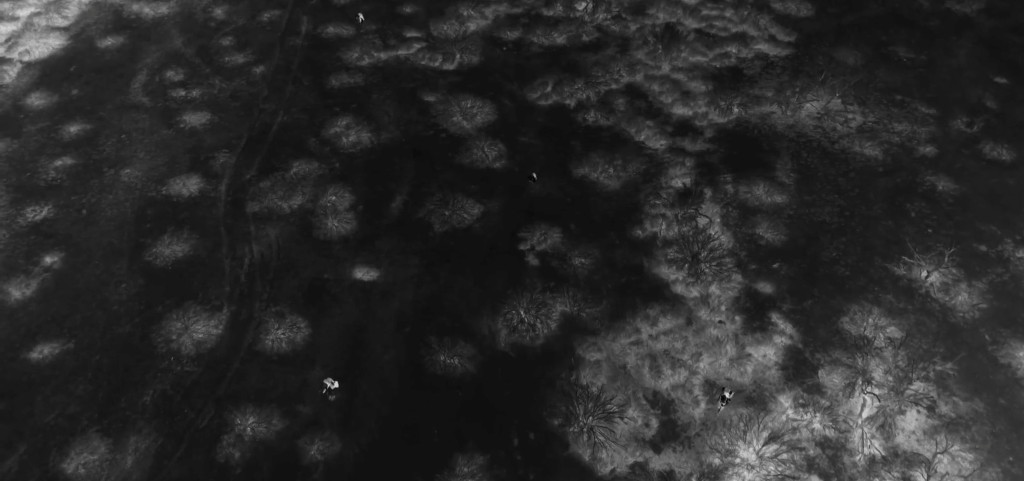
Intercut throughout these chapters are images shot through infrared technology. People navigate inhospitable terrain at night, hoping that darkness ensures safety. However, the negative imagery reminds us that someone’s always watching. A photographer’s eye and a lawyer’s sensibility afford the film an empathetic lens without exploiting anyone who doesn’t consent to being photographed. For a film that captures cameras all over the place, it takes to heart the ethical choices of how and where one points a camera.
“I’m so grateful to have had the experience of being a lawyer and being trained in that world because it means I can understand what the structure of international law looks like, what people are entitled to,” says Pinto. “The film took six years to make, and a lot of that access required time and relationship building.”
“Most of the best scenes in the film are just KJ by herself,” adds Nakhai. “There’s no way we would’ve been able to film that scene in the airplane with another person or with a director of photography.” Nakhai notes that the intimate and experiential nature of the film is partly by intent and partly a result of the parameters of the project. Much of The Sandbox results from a minimal crew observing liminal spaces so that audiences can experience what it’s like to navigate these areas under a governmental panopticon.
Besides Pinto, the film draws upon the work of additional cinematographers when The Sandbox plays in spaces that are more open, from the desert to the choppy waters of the Mediterranean with director of photography Luc Forsyth and a riveting sequence aboard a rescue ship shot by Gabriela Osio Vanden (who won the Grand Jury Prize at Sundance for Nuisance Bear earlier this year).
That sequence shows the Sea-Watch Nautical Crew doing the opposite of what Ramón experienced with the Adriana. The people aboard the Nautical Crew monitor for migrant boats in distress in order to save their passengers. The film watches as they rescue migrants from the waters, in some cases observing and reacting in real time as people jump from moving boats because they feel the open water’s a better option.
“It’s harrowing to watch,” admits Pinto. “It is something that these volunteers are doing. They go out and they do this work, and it was amazing to watch them do that. The people who are crossing are experiencing a very, very harrowing moment themselves. It was a culmination of us being out there for quite a while with them.” That one sequence comes from a three-week stint with Sea-Watch and watching and waiting with the rescue crew.
“We didn’t know what we might see, but we knew we were going to see something because it’s so common, because there are so many people trying to cross,” says Pinto. “That’s what is quite disturbing. We see this little snapshot of a moment in time, but there is so much that we don’t see.”

Elsewhere, the film slows down and takes in the methodical nature of being a watcher as it connects with an anonymous digital archivist in Nairobi. She scrolls through videos daily and can recognize patterns in human behaviour across the globe, or detect an illness in someone simply by the way they move. Meanwhile, people in refugee camps in Kenya are subjected to digital documentation to which they might not consent otherwise as they seek shelter.
When asked about the globe-trotting nature of The Sandbox, Pinto says she partly went where the research took her but also drew upon her own personal and professional experiences that inspired the project. “I started following the work of academics and being on the ground in Greece, and then it made sense to go to the largest refugee camps in Kenya, not only because that’s where I grew up on the coast, but also because it felt like a very clear genesis of the colonial project and trying to connect these places with a thread that people could understand,” explains Pinto. “The tech is evergreen. We’re going to have something different tomorrow, ten years from now, but the power dynamics that underlie that technology and the political will that guides that technology is what I think is interesting.”
In El Paso, Texas, meanwhile, a tech fair promotes the latest in technological warfare and cutting-edge surveillance gizmos for the gatekeepers. Pinto observes boys with their toys who engineer a global game without having to experience the consequences.
The tradeshow, like so many other spaces the film enters, so vividly exemplifies Emmanouilidou’s concept of “the sandbox” that gives the doc its name. “When I think about the sandbox, I think about play. I think about a space to experiment, to build, to destroy without consequences. There are powerful economic forces at play, global markets and corporations that depend on this system, and they require the participation of everyone in it,” Emmanouilidou says in voiceover. “Every player has a role and it’s by design that nobody can see the full picture.”
Pinto says that observing the interactions between people and technology over the six-year production puts the prevalence of the sandbox metaphor into perspective. Her film gives audiences fragments with which to see the fuller pictures of what is happening to migrants globally.
“Some of the footage that we shot in the States was during a previous administration that, by all accounts, wasn’t right leaning,” Pinto observes. “It requires the participation of so many different actors for this system to keep working, and that includes traditionally liberal institutions and governments as well. In the Canadian context, we’re not immune either. We have also participated in purchasing many of these border technologies as well. And so, we’re not so far away from what is happening.
“We’re certainly part of the broader system. The film offers an overview of the landscape that implicates a broad variety of actors.”
The Sandbox screens at Hot Docs and DOXA.
Get all of our Hot Docs coverage here.
The post How The Sandbox Explores Human Costs of Eyes in the Sky appeared first on POV Magazine.