
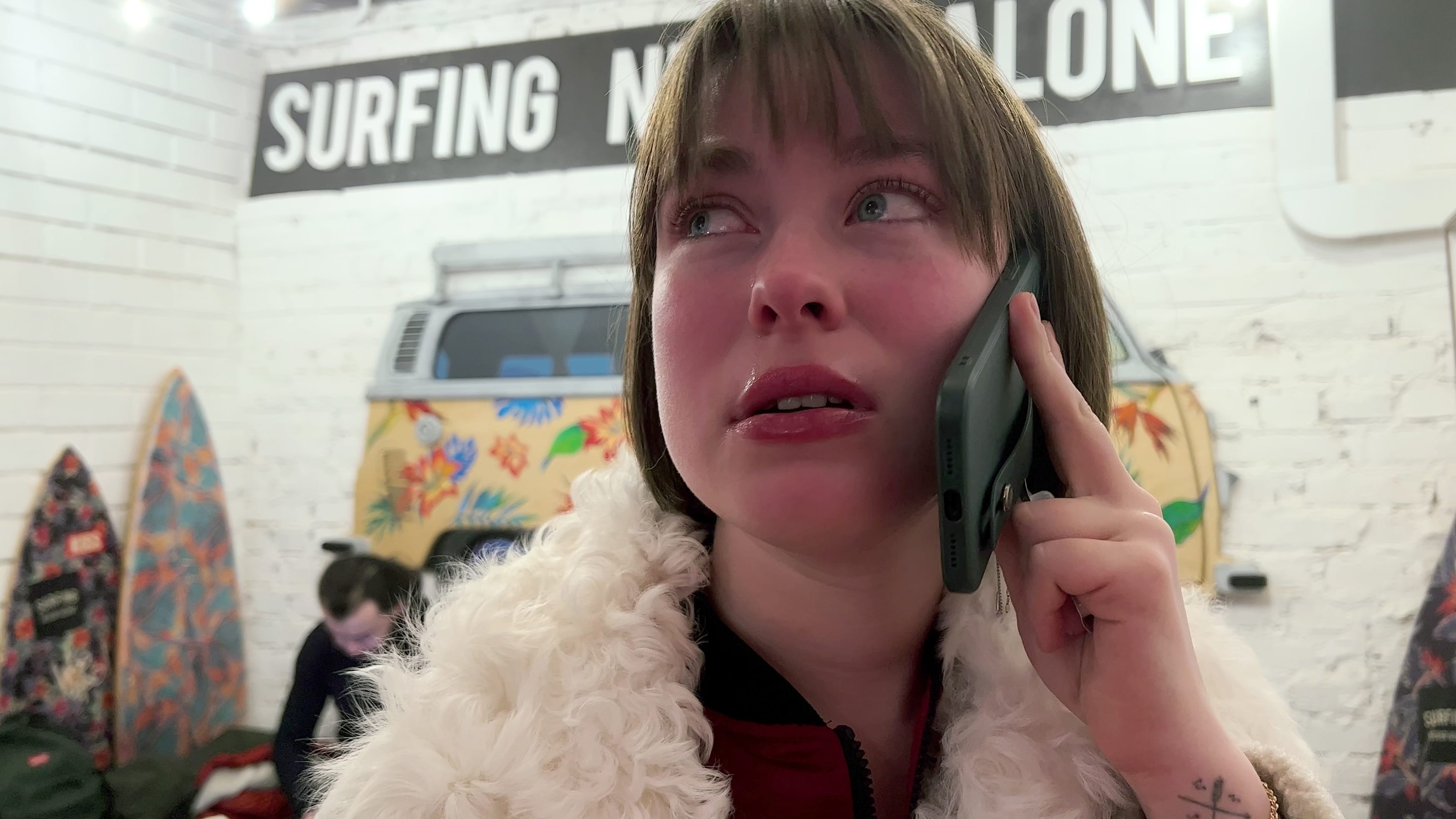
With a runtime of more than five hours, My Undesirable Friends: Part I – Last Air in Moscow might seem like overkill. Couldn’t an editor have cut the thing down to average feature length and still gotten its point across? The documentary follows seven women journalists in Russia in the months leading up to their country’s invasion of Ukraine and then during that tense first week of the war. Early into the film (that is, a little over an hour into its runtime), we learn that almost all of these women will end up leaving Russia when the last of the nation’s independent media outlets are shut down. That simple premise could be told more briefly. Indeed, Askold Kurov’s latest documentary, Of Caravan and the Dogs, depicts the same timeframe in just 90 minutes. The 2023 Frontline episode Putin vs. the Press, focused on Nobel Peace Prize winner Dmitry Muratov and his newspaper, Novaya Gazeta, is only 53 minutes.
All of these documentaries involve Russia’s “foreign agent” law, which is used to label any NGOs, media outlets, or independent journalists not in agreement with Putin’s propaganda as enemies of the state, influenced by the West. The distinction of My Undesirable Friends is that it’s an immersive, character-driven film more than just a record of recent events. We spend so much time with these women that it becomes personal rather than merely historical. Still, as a record of recent events, it’s the sort of documentary that shows history as it’s occurring. Despite the captions that foretell what will happen to these characters well in advance of showing these outcomes playing out on screen, the story unfolds in a linear chronology that gives us the sense that we’re experiencing it in real time. That’s not to say it’s slow, let alone that it feels longer than its 324 minutes. Quite the opposite, the film flies by the deeper you get.
Thanks for reading Nonfics! This post is public so feel free to share it.
Because the director, Julia Loktev, is close to some of the characters and films them with only an iPhone and no additional crew, My Undesirable Friends is more intimate than most observational documentaries of its kind. Yet, it’s still removed enough not to feel overly involved. Loktev makes a point to feel present without interacting much. The women often talk to her directly, but they might as well be talking through her to get to the audience. Loktev has acknowledged that she wanted her lens to be like a stand-in for the viewer, and that is the effect. Enough that maybe the title should be Your Undesirable Friends. And who knows, maybe this virtual sense of being embedded among political outcasts will be foreshadowing for Americans at a time when this country appears to be going down a similar path. Where Petra Costa’s new film, Apocalypse in the Tropics, plays like a remake for American viewers, My Undesirable Friends could be a prequel. Never mind that the film is already spawning a sequel.
As with a TV series, or a novel, or any narrative medium, the longer you’re engaged with characters, the more you should be invested in them, and that’s part of why the runtime is less of a problem as it goes on. But even looking back afterward, I couldn’t tell you much about most of the individual women. A few worked at the independent news channel TV Rain, a couple of them collaborated on a podcast called Hello, You Are a Foreign Agent, another two of the women worked for Important Stories, and one worked for Novaya Gazeta. But their lack of distinction is just reality. Not everyone in life gets an easily defining arc, though one character in My Undesirable Friends does have a more compelling story within the broader narrative. Kyusha has a fiancé who is in jail for alleged treason, and this adds a greater bit of drama when all of these journalists consider fleeing Russia at the end of the film. She has the most to leave behind. She will be the one I’m most interested in continuing to follow (assuming she’s still part of it) when My Undesirable Friends: Part II – Exile is released.
Nonfics is a reader-supported publication. To receive new posts and support my work, consider becoming a free or paid subscriber.
While the platform of choice for My Undesirable Friends is theatrical, I assume that more people will eventually see the documentary digitally at home, and I want to address its runtime and how to watch it. The theatrical release implies it’s a lengthy, five-and-a-half-hour feature with an intermission, but it’s also divided into five chapters, each of which concludes with a short credits sequence. If it’s to be released online or via a streaming service as a series, this documentary should still be watched in as few sittings as possible. That’s to get the best impression of the intensity and immediacy of what these women are going through as they wonder about their country and their freedom. Even with those foretelling captions, the film plays like a political thriller if you allow yourself to be empathetically entrenched with the characters as they fear being followed, raided, abducted, detained, or worse.
As a film about journalists, My Undesirable Friends paints a heroic picture of professionals who aren’t well paid, aren’t well-respected enough by the public, and are under constant threat of imprisonment or death, but who believe that the truth and accountability matter. There aren’t a lot of triumphant stories of journalism right now, and nothing as big as what’s depicted in Hollywood movies like All the President’s Men or Spotlight. Not only are journalists having less of an impact than they should or used to, due to misinformation and widespread accusations of biased or fake news by those who might be exposed, but many are killed while doing their jobs. Not just as collateral damage, either; some are murdered in targeted attacks. The profession isn’t the most appealing at the moment, which adds to its endangerment. But there is triumph in the strength and integrity these women exhibit, no matter their results.