
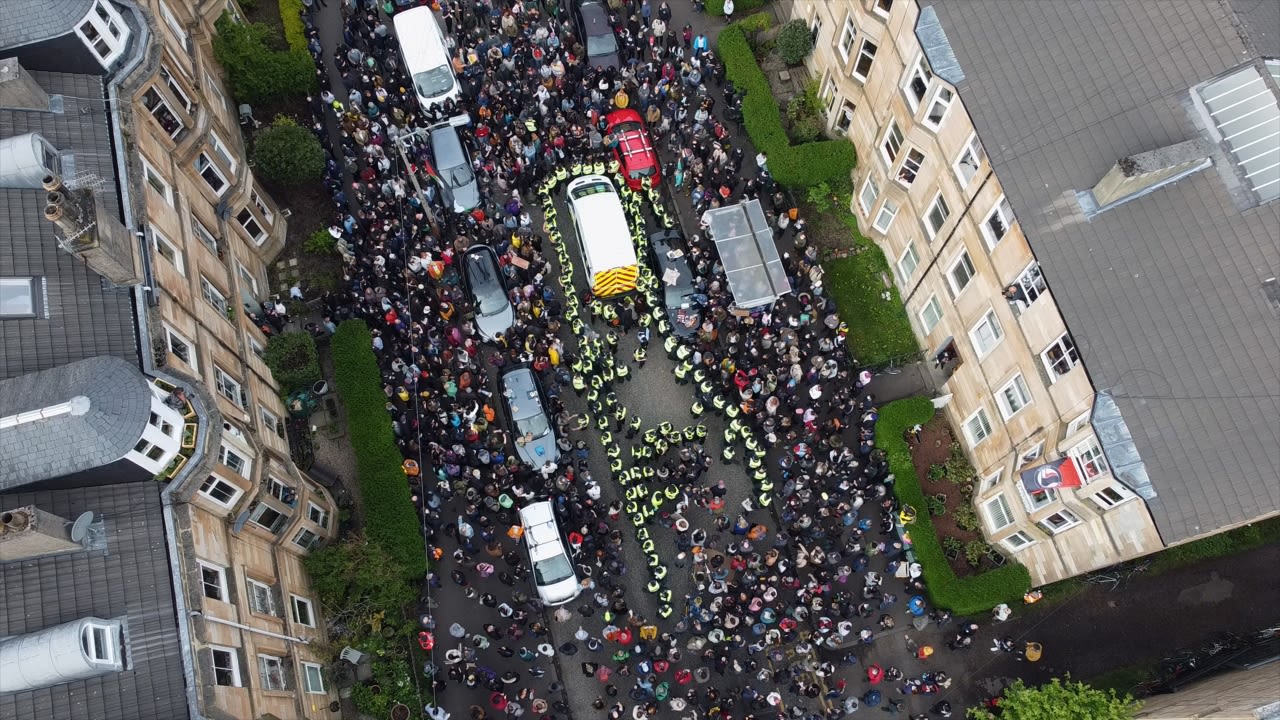
You can’t judge a documentary by its synopsis. Everybody to Kenmure Street sounds like a simple, conventional political film when all you have to go on is what it’s about (a day-long spontaneous protest in the titular location in Glasgow in 2021 after two locals are detained in an immigration raid). For this exceptional documentary, you need to know how it’s about it. That’s where we critics come in. Not just to tell you more, like how it’s a combination of archival footage, interviews, and dramatizations. That definitely doesn’t sell this brilliantly constructed film, which will be added to our ongoing list of the best documentaries of 2026.
Everybody to Kenmure Street begins with an archival montage traversing centuries of political protests in Glasgow before landing on the date in focus. To show what happened, director Felipe Bustos Sierra sourced video of the Kenmure Street protest from cellphones and media. To tell what happened, a variety of eyewitnesses, participants, activists, and local leaders are interviewed in some of the most uniformly well-designed talking-head shots I’ve seen in a long time. A few individuals are anonymously portrayed in dramatized scenes by actresses Emma Thompson (who is also an executive producer), Kate Dickie, and Keira Lucchesi, who speak their counterparts’ words while acting out moments from the protests. Thompson’s role has her lying under a police van the entire movie, in place of the unknown man she plays.
Nonfics is a reader-supported publication. To receive new posts and support my work, consider becoming a free or paid subscriber.
Those dramatization scenes reminded me of Clio Barnard’s The Arbor, while the rest of the film had me recalling Jose Padilla’s Bus 174. The latter is similarly about a crisis involving a vehicle surrounded by police, media, and many others, in a way that was heavily captured on camera and therefore beneficial to filmmakers looking to piece together images of the day. We get to feel like we’re watching events unfold in real time, albeit condensed. We may even feel like we’re there with the community coming together, and that’s perfect since the film isn’t just about that day; it’s also a reminder of the unity in community. It’s a reminder, emphasized by a centerpiece archival history montage, that the rich and powerful try to divide those they wish to exploit to keep them from rising against them.
There’s really only one element to Everybody to Kenmure Street, and that’s fantastic filmmaking. The various approaches on display are so cohesive that it’s like they’re one. From the outsourced footage to the interviews and the dramatizations, it’s incredibly fluid. I really can’t stop thinking about the beautifully composed interviews, especially one with a protester wearing the same outfit he wore on the day, adding to the consistency of all the material. If there’s any part that breaks that flow, it’s the middle montage, which plays like a parenthetical flashback. But it also provides deep historical context about the setting, elevating the film from an experience to a revelation. It’s a creative work in addition to being important and inspiring, and that makes the latter traits more effective.
Thanks for reading Nonfics! This post is public so feel free to share it.