
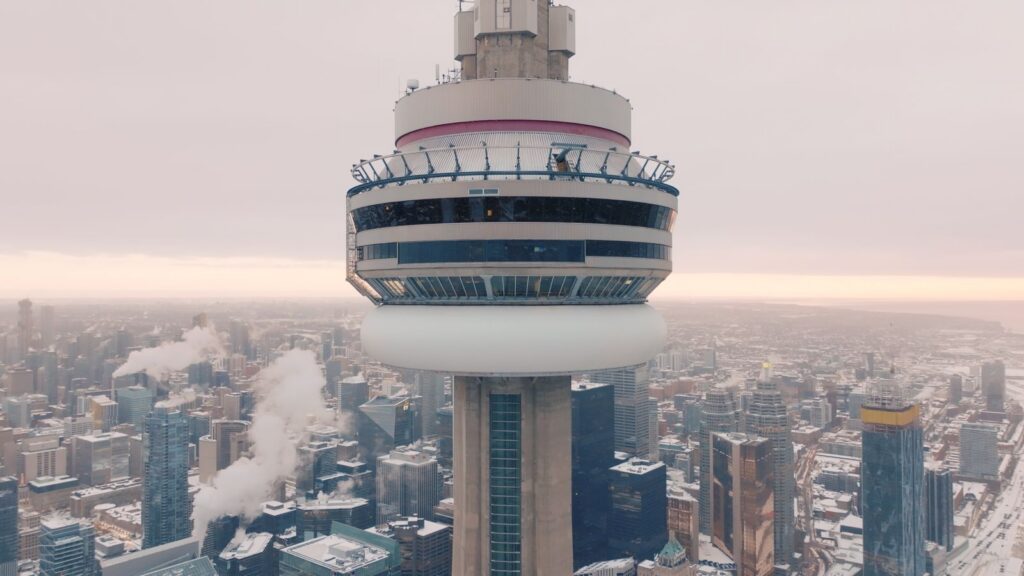
On Toronto’s lakeshore stands a talisman of sorts, a pointed symbol for the city’s last half century of explosive growth and transformation. Soaring over 550 metres into the sky, the elegant rise is dotted with two bulbous areas for visitors, creating a unique silhouette that is indelible as any other aspect of this sprawling home to millions.
Mark Myers’ The Tower that Built the City uses the iconic CN Tower as a touchstone to explore these massive cultural, social, and political shifts that have transpired over the last half century. Through a series of archival materials, new interviews with some of the hands that helped build the structure, and other interviews with figures from entertainment and sport who have helped make the city what it has grown into, the film provides an unabashedly celebratory look at the various facets of what it means to live and work in Toronto.
While it’s no longer the tallest freestanding structure in the world, surpassed by multi-billion dollar projects on the other side of the globe, there’s still much to admire not only about what the CN Tower represents, but how it has serves technologically as a literal beacon for cultural transmission, but also an element that is indelibly associated with this city’s skyline.
POV spoke to Myers prior to the film’s world premiere at this year’s Hot Docs film festival.
POV: Jason Gorber
MM: Mark Myers
This interview has been edited for brevity and clarity.
POV: What was your introduction to the CN Tower?
MM: It probably was driving down Toronto’s Don Valley Parkway as a young child. I was born in Scarborough and probably my first experience was seeing it peek out driving south down the DVP.
POV: Do you remember having a particular affinity for it during your childhood?
MM: I remember going downtown with my mom as she took me to the Eaton Centre to do shopping, going to baseball games with my oldest brother, going down into the city, those are probably the core memories. The Tower to me represented going downtown, entering the big city. You were doing something special when you were headed down the DVP. But to note, I did want to make the movie as if I wasn’t such an insider or local. I wanted to look at it from an outsider or tourist’s point of view to some extent, rather than as a flag-waving, internal story.

POV: What led you specifically to focus on the Tower and at what stage of the project did you know the Tower would become a symbol for the city itself?
MM: I was watching a master class by Ken Burns. He talked about his first feature film, a documentary called The Brooklyn Bridge, and that ended up being nominated for an Oscar. He was just talking about how he brought that story to life through what we now know as the “Ken Burns Effect,” using photographs and all of that stuff. Hearing that, a lightbulb went off.
I thought of our inferiority, as Canadians, as Torontonians, and how we tend to avoid celebrating our accomplishments. We tend to suffocate them a little bit. I realized that if the Brooklyn Bridge is a worthy story, surely the CN Tower is! It could be the lead character of my film.
I quickly realized I didn’t just want to make a ‘making of’ documentary about the tower’s construction, knowing that those films existed 50 years ago when they built the thing.
POV: You present not simply the tower that they intended to build, but also show how perception of it has changed as the city that surrounds it has undergone tremendous change.
MM: I feel like the Tower mirrors my own growth as a human. As a kid, I looked up to it. I couldn’t think otherwise. It represented downtown, it represented the city. It was bold, it was ambitious, it was a big thing. As I grew older, maybe as I became more aware of myself, more unsure of myself, more aware of CanCon, more aware of Canadian content vs. American content, the Tower in my mind started to represent that very thing: Canadian content, and Canadian content meant “less than,” something not as good, or cheaper. If I saw the Tower in a show or something, you immediately knew, “Oh, this is Canadian,” and you knew that it didn’t quite match up to our American content that we were getting.
I feel like the tower has had a resurgence of sorts. It has gone on its own hero’s journey, or even an underdog story, if you will. We all look at the tower kind of as a beacon, as a symbol. It represents home, it represents downtown. But its actually serves a purpose, which is telecommunications. So then I thought, “Oh, well, this is interesting. This symbol that represents us also amplifies who we are outward.” There’s a collision of form and function, the symbol and the functionality of culture.
That’s where this notion of it being a literal cultural amplifier started to come into the story. I really did want to make a kind of cultural doc in the way that the O.J.: Made in America succeeded. I thought that film did a good job at looking at history through a cultural lens.

POV: Could talk about your process of finding who you wanted to talk to and how excited many of them were eager to talk about this city that we’re often reluctant to champion?
MM: I was very lucky to get the people I did interview. I had a laundry list of many more. I’m sure you’d know sometimes how difficult it is to get the people you want.
POV: Really? Was Drake too busy?
MM: He was number one on my list when I started this. I thought, Drake’s going to be an executive producer, this is going to go to a film festival and win an audience award. That was my checklist of things to do! I tried five, six different angles to get to Drake. In fact, the doc was at one point called Views: The Rise, Fall and Rise of the CN Tower [akin to Drake’s 2016 album title]. Alas, I didn’t get Drake.
Many of the people I reached out to were actually involved with constructing the tower. Many suggested that I shouldn’t even bother making a doc about the CN Tower, I’m too late, the important people have passed away or are too old, that ship has sailed. I figured if people can make a doc on the pyramids, or on the Brooklyn Bridge, then clearly one can make a doc on the CN Tower. It’s only 50 years old!
My first interview was with the project architect. I was in New York for another project, so I took a train over to his house and got what was known to be one of the more important architects. There was a lot of controversy surrounding the tower. Everyone seems to want too much credit, and then they get slapped on the wrist for it. Anyway, I got the project architect, I went to Montreal and got the structural engineer, so I was off to the races, making sure I was getting the people who were actually involved from the beginning.
There’s a guy named John Andrews, who is known to be the main architect of the CN Tower. It was his design firm that put it together, along with [the Toronto firm] Webb Zerafa Menkes Housden. Turns out he’s an Australian, he lives in Australia, and he wasn’t well. I was going to get a camera crew over there to film him, but he lives in the middle of nowhere. I was lucky enough to have a phone interview with him, and then, sadly, he did pass away only two months after I interviewed him. I was very happy and pleased to get his voice and his perspective in the film.
Because I wanted this to be a culture doc, I wanted athletes, musicians, artists, directors, photographers, I wanted it from every angle possible, so I was lucky enough to get Doug Gilmore, Joe Carter, Steve Nash. What I like about getting Joe, although people might point and say, “He’s not Canadian, why is he in it?” But that’s another aspect that I wanted to take, which is an outsider’s perspective, slightly. He is Canadian.
The project architect is American, the other architect is Australian. Steve Nash, I did like the outside perspective of being a West Coaster looking in at what Toronto, the CN Tower, meant.
POV: You have Caitlin Cronenberg as an interviewee and Executive Producer. Could you talk about her involvement because she’s somebody that has internationalized the vision of that image?
MM: She wasn’t initially on my list of people to interview, as I actually didn’t know who was the photographer of Drake’s Views album cover. To me, that image of Drake sitting on the tower like he’s on a couch, that’s the climax of my third act. Beyond that, Caitlin was great in reviewing the film, providing some notes, and just being a general supporter of the film and the project.
POV: And at what point in time did you watch Nirvanna: The Band The Show The Movie and think , “I’m going to add some clips in from this?”
MM: Well, I’m a sneaky guy, so I brought my camera to the premiere. That was the footage of them at the Royal Alex. The very last clip I added was actually during my audio mix, I went back and added one more Nirvanna to show the movie clip in to the film at the 11th hour.
POV: Could talk about the balance of putting it all together, of making sure it wasn’t simply self-congratulatory? There’s a difference between the kind of stuff you would play for your friends and stuff that you want to speak to people who frankly don’t give a damn about the city but will still get something rich out of the film.
MM: As I mentioned earlier, I didn’t want this to be just an insider’s guide to Toronto and something only Torontonians would want to watch and support. As people often say, in its specificity are universal themes. I just thought that the story of an underdog city, especially once I did more research and realized its relationship to Montreal and how Montreal was the metropolis.
POV: One way you do that is to show how vital immigration is to the city that Toronto has become.
MM: This is arguably the most multi-cultural city in the world. There’s a 50-year-old document early in my film where it says, roughly, that the tower was constructed by people from around the world that came to even help build the city itself.
POV: The film is getting its release at Hot Docs, what does that mean to you as a Toronto boy, being showcased in Toronto?
MM: It’s very meaningful! When I got the phone call that they doc was selected and it’s in Special Presentations category, I nearly shed a tear. It’s been a long journey to try to finalize, to make sure I was making a doc worthy of the city, the Tower, and myself. The timing just worked, everything feels like it was culminating just right. The CN Tower’s 50th anniversary is at the end of June, so when I started this project years and years ago, it was all leading to this moment. If I didn’t get into Hot Docs, it was going to be a bummer!
POV: You’re a Myers from Scarborough, but another Myers found success by leaving Canada. He’s still maintained a deep Canadianness, but he left Canada for his career. Why do you as an artist continue to work in this country?
MM: My entire family moved to the States. I’m the youngest of six kids, and everyone went south and is still there. Why do I still live and work here? I have an affinity to Toronto. I went to school at University of Toronto, partly because I grew up just on the outside of the core of the city and never really got to know it. I purposely went downtown just so I could more intimately know the city that I grew up around, and I’ve been here ever since. Would I be open to finding success elsewhere? I am. But am I happy and thrilled to be able to make content in the city that I love? I am.
The Tower that Built a City premieres at Hot Docs on May 1.
Get all of POV’s coverage from the festival here.
The post Views: How the CN Tower Documentary Captures Toronto’s Iconic Landmark appeared first on POV Magazine.